
So very true via pinterest. A big thanks to Amanda for bringing this to my attension
Images that move me

by Langdon Graves
Monday, June 18, 2012
Friday, June 15, 2012
Who doesn't love the sincere hopeful attempts of a T-Rex? (they have little arms!!!)
T-Rex Trying…:


A cute little blog packed with drawings of The Tyrant Lizard King trying…! Created by Hugh Murphy. Go check it out here
Thursday, June 14, 2012
"Complaining Is Stupid. Either Act or Forget."
"Complaining Is Stupid. Either Act or Forget." [Quotables]:

This quotation comes from graphic designer Stefan Sagmeister and is a good reminder that sometimes we need to stop being angry, shut up, and actually do something. More »


Wednesday, June 13, 2012
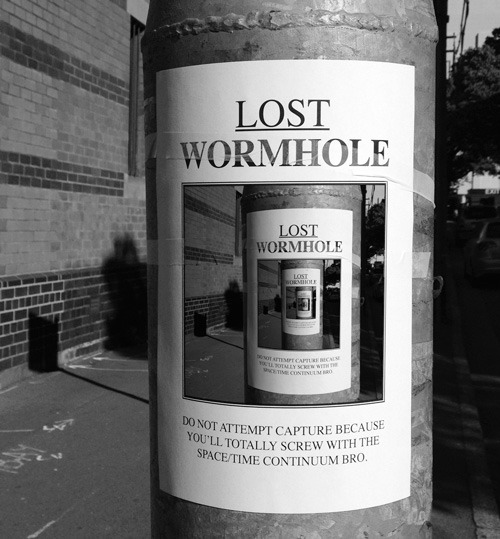
I love the mind of this thing's creator.
Funny "Lost Wormhole" sign:
An unknown human produced this funny LOST WORMHOLE sign. Have you seen the missing singularity?

Lost wormhole
(via Beth Pratt)


Digital Bill of Rights
Digital Bill of Rights:
The two reps who led the Congressional fight against SOPA have unveiled a draft bill of rights for the Internet. Reps Darryl Issa and Ron Wyden unveiled their proposal at Personal Democracy Forum, and invite the Internet to edit and refine the list on Keep the Web Open.
1. The right to a free and uncensored Internet.
2. The right to an open, unobstructed Internet.
3. The right to equality on the Internet.
4. The right to gather and participate in online activities.
5. The right to create and collaborate on the Internet.
6. The right to freely share their ideas.
7. The right to access the Internet equally, regardless of who they are or where they are.
8. The right to freely associate on the Internet.
9. The right to privacy on the Internet.
10. The right to benefit from what they create.


Tuesday, June 05, 2012
Friday, June 01, 2012
CISPA—time to kill this sucker
CISPA—time to kill this sucker:

Zak from Fight for the Future/Privacy is Awesome sez,:


Zak from Fight for the Future/Privacy is Awesome sez,:
It's only days before the Senate votes on its version of CISPA, and the SECURE IT Act. The bill would open all your data up to the government, no matter how personal. Good bye privacy, hello police state. Since the vote is soon, anything we do at this point has a big impact, so if you care about your privacy, stand with us and take these actions:
The first thing you can do is change your Facebook cover photo to show your friends the creepy records government will be keeping on us if CISPA passes.
There's another thing you can do to send your message even stronger. Visit a Senator's office and deliver this explanation of how CISPA and SECURE IT would trample our privacy, or mail it in if you can't visit in person. Tons of people will be doing this. It's the best way we can educate our senators; a disturbing number of them don't really understand what they're about to vote on.
Internet governance shifting from civil society to government, and getting less free
Internet governance shifting from civil society to government, and getting less free:
James from the New America Foundation sez, "I wanted to share this blog post on why civil society voice is essential in Internet governance and some efforts shift control to government-only entities:"
Giving Civil Society a Voice in Internet Governance
(Thanks, James!)


James from the New America Foundation sez, "I wanted to share this blog post on why civil society voice is essential in Internet governance and some efforts shift control to government-only entities:"
While Indian courts are attempting to control content domestically, a simultaneous effort from India’s national government is focused on increasing governmental control of the global Internet. Last October, India submitted a proposal to the United Nations for the creation of a UN Committee for Internet-related policies (CIRP). CIRP would be a government-only body tasked with overseeing Internet governance and standards setting.
This would alter the current landscape of international Internet governance, which is a multi-stakeholder process including civil society as well as government actors. The US-based public policy organization Center for Democracy and Technology describes the current model as "bottom-up, decentralized, consensus-driven approach in which governments, industry, engineers, and civil society" contribute to policy outcomes. The distribution of Internet Protocol (IP) addresses and top level domains, for example, is managed by Internet Corporation for Assigned Names and Numbers (ICANN), a non-profit organization. Organizations like Internet Engineering Task Force and the World Wide Web Consortium work together with engineers to develop standards.
Giving Civil Society a Voice in Internet Governance
(Thanks, James!)
Thursday, May 31, 2012
Wednesday, May 23, 2012
Friday, May 18, 2012
Ken Burns: On Story
Ken Burns: On Story:
What makes a great story? For legendary filmmaker Ken Burns, the answer is both complicated and personal. In this short documentary about the craft of storytelling, he explains his lifelong mission to wake the dead! Very interesting talk if you havent seen it already
What makes a great story? For legendary filmmaker Ken Burns, the answer is both complicated and personal. In this short documentary about the craft of storytelling, he explains his lifelong mission to wake the dead! Very interesting talk if you havent seen it already
Thursday, May 17, 2012
Thomas Allen’s Pulp Fiction Pop-Up Photographs
Thomas Allen’s Pulp Fiction Pop-Up Photographs:


Always Fascinated by pop-up books, Thomas Allen displays an infallible talent for the creation of the illusion of three dimensions, using old pulp fiction books as the subjects for his sets.These books tattered covers and yellowed pages are not mere objects to display on a shelf, for the artist but a prodigious inventory of actors and scenes, just waiting to be directed.
Allen patiently cuts out the figures, freeing them from their two-dimensional state: the actors are then raised from the covers and come alive thanks to skillful use of lighting and the camera’s lens. Bent and positioned, the scripted drama is staged, bringing to life the stories written and not written in the books that act now as the stories stage.


Always Fascinated by pop-up books, Thomas Allen displays an infallible talent for the creation of the illusion of three dimensions, using old pulp fiction books as the subjects for his sets.These books tattered covers and yellowed pages are not mere objects to display on a shelf, for the artist but a prodigious inventory of actors and scenes, just waiting to be directed.
Allen patiently cuts out the figures, freeing them from their two-dimensional state: the actors are then raised from the covers and come alive thanks to skillful use of lighting and the camera’s lens. Bent and positioned, the scripted drama is staged, bringing to life the stories written and not written in the books that act now as the stories stage.
Wednesday, May 16, 2012
This made me cry today: Woman controls robot arm with her mind
Woman controls robot arm with her mind:
In this video, a woman known as Cathy, who is unable to speak or move any of her limbs or torso, controls a robot arm with her mind to take a sip of coffee. This fantastic breakthrough is reported in the current issue of the science journal Nature. Cathy has been implanted with a BrainGate neural interface (below left), the same technology that previously enabled two individuals to control computer cursors with thought alone. One of the lead researchers is Brown University neuroengineer Leigh Hochberg. I visited Leigh more than 13 years ago when he was a grad student at Emory University. He introduced me to monkeys who had received neuroimplants in his lab. At the time, Leigh was just trying to record the signals from the monkeys' brains while also dealing with the implants' proclivity to move around, reducing the quality of the signal over time. Leigh was humble, cautiously optimistic, and deeply dedicated. Amazing how far this research has come. From Nature:


In this video, a woman known as Cathy, who is unable to speak or move any of her limbs or torso, controls a robot arm with her mind to take a sip of coffee. This fantastic breakthrough is reported in the current issue of the science journal Nature. Cathy has been implanted with a BrainGate neural interface (below left), the same technology that previously enabled two individuals to control computer cursors with thought alone. One of the lead researchers is Brown University neuroengineer Leigh Hochberg. I visited Leigh more than 13 years ago when he was a grad student at Emory University. He introduced me to monkeys who had received neuroimplants in his lab. At the time, Leigh was just trying to record the signals from the monkeys' brains while also dealing with the implants' proclivity to move around, reducing the quality of the signal over time. Leigh was humble, cautiously optimistic, and deeply dedicated. Amazing how far this research has come. From Nature:
"Mind-controlled robot arms show promise"
The (latest) study participants — known as Cathy and Bob — had had strokes that damaged their brain stems and left them with tetraplegia and unable to speak. Neurosurgeons implanted tiny recording devices containing almost 100 hair-thin electrodes in the motor cortex of their brains, to record the neuronal signals associated with intention to move.
In a trial filmed in April last year and presented with the paper, Cathy, who had her stroke 15 years ago and received the implants in 2005, used her thoughts to steer a robot arm to grasp a bottle of coffee and lift it to her lips. She drank and smiled.
‘We’ll never forget that smile,” says Hochberg...
In the longer term, the scientists want to dispense with the wires that must be attached to a patient’s skull; wireless systems are in development… Even further in the future, researchers hope to dispense with the robot arms and direct the decoded brain signals straight to the patient’s own muscles.


Subscribe to:
Posts (Atom)